Beyond 02466
By Samantha Mocle
By Samantha Mocle
“Our vision for Lasell is to apply our educational philosophy in nontraditional spaces to create economic impact for learners, employers, and communities at large. We’re casting a wider net with our residential campus as an anchor, a guiding light, to mobilize in different industries and geographic locations.”
— Cris Haverty, Assistant Vice President of Workforce Development and Global Engagement
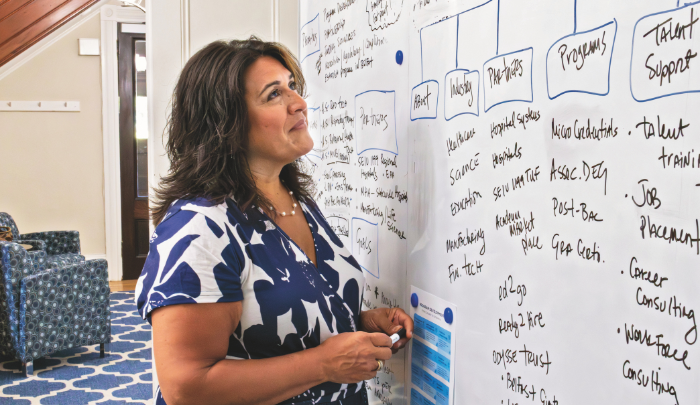
Multi-directional arrows, stacks of bullet points, and diagrammed ideas fill a giant whiteboard in Cris Haverty’s campus office. Though she’s been at Lasell for more than 25 years as a faculty leader, her comparatively new role in talent transformation and workforce development (WFD) finds her taking everything we know about higher education and rearranging it to meet the needs of every learner—not just “traditional” undergrads.
“This is where higher ed is going,” says Haverty. “We’ve been around for 175 years because of our forward-thinking mentality and adaptation,” she says. “And we’ll be around for another 175 by sharing our philosophy—that learning is for every person, at every stage of life—with new audiences.”
That starts with using the University’s existing models for education and community as a compass for what comes next. Haverty points to the Newton campus’s geographical vantage point between Boston and the Route 128 corridor as “one of Lasell’s greatest assets.” And though higher education continues to evolve, she and the rest of the University’s leadership team know that traditional undergraduate experiences on a close-knit campus matter. Exponential growth, she says, will not happen at the expense of our core values.
"What sets Lasell apart from other educational institutions is our demonstrated ability to meet the needs of learners in every stage of life," says President Eric M. Turner.
In the two years that Haverty has led WFD efforts, she’s built a robust institutional track record of technical, clinical, and professional programs. A surgical technology certificate, initially established in partnership with Newton-Wellesley Hospital, has since evolved into an associate’s degree program offered through three additional hospital systems with more than 60 graduates now employed in elevated roles.
Programs like these are created in partnership with industry stakeholders from the start to guarantee that curricula and outcomes meet the needs of educators, employers, and learners. A successful program, says Haverty, “meets learners where they are and meets the current and future demands of the labor market.”
This is done through multiple entry points and modalities to provide flexible higher education options through a “learn and earn” approach.
When done correctly, workforce development allows a parent working full time just as many options to build their credentials as a seasoned executive looking to change career paths, or a senior adult looking to learn a new trade (“reskill”), or a technical worker eager to upskill.
Haverty takes it one step further by embedding requirements and industry-recognized credentials within credit-bearing classes so that, even if the desired outcome of a program is a certification, for example, those enrolled also leave with University credits to their name. Lifelong learning, in this instance, is both a philosophy and a modus operandi.
“We physically live that approach,” says Haverty, referring to Lasell’s intergenerational campus learning community: two early childhood centers, a senior living facility, and a university. “Now we’re expanding our footprint. We know that higher education is frequently under fire, but we also know its value”

Goal: Upskill incumbent employees at Cape Cod Health Care, UMass Memorial Health, and Beth Israel Lahey Health hospital systems
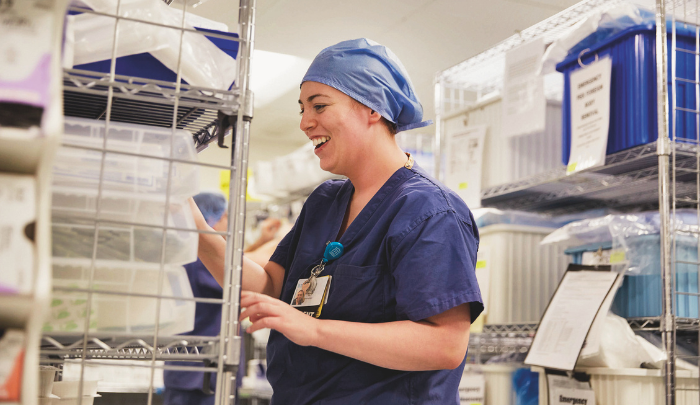
GOAL: Train incumbent healthcare employees for economic mobility through operating-room-adjacent positions

GOAL: Provide a flexible option for learners to reskill and complete prerequisite requirements for advanced degree healthcare programs

GOAL: Train and upskill the people of Northern Ireland, the rest of the United Kingdom, and beyond to respond to high regional workforce demands

GOAL: Provide practical, in-demand, skills-based learning experiences for career advancement through an online, self-paced environment
Additional programs in the discovery phase include those in high-demand healthcare areas, including radiological technology and respiratory therapy.
Leaves readers interested in reskilling toward a new career path or in upskilling employees in their workplace can reach out to Cris Haverty for more information.